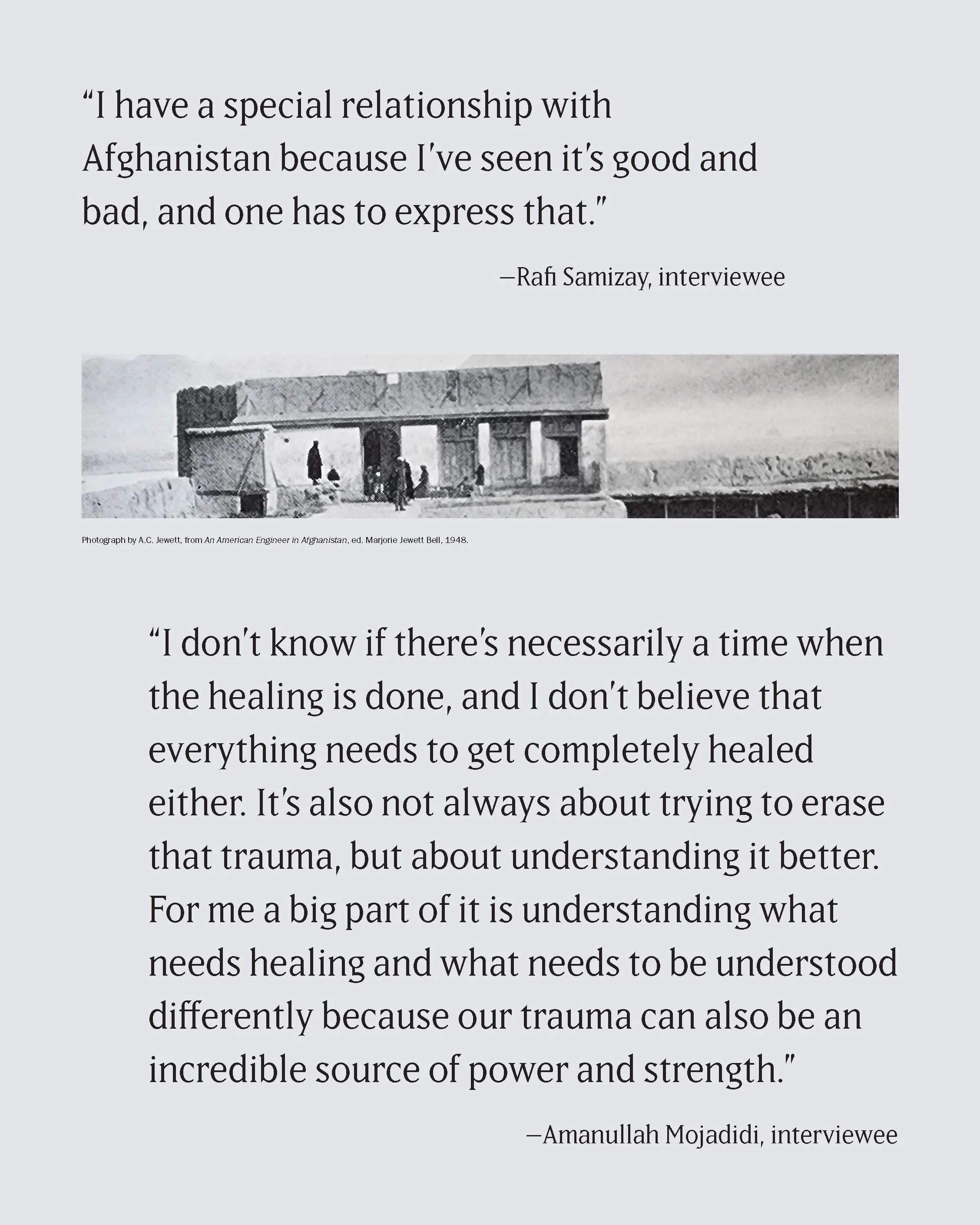
Home is an idea as much as it is a physical structure, transcending borders and generations. “Wazir Akbar Khan,” a neighborhood in Kabul whose name my father, Rafi Samizay, adopted to refer to the home he designed and built in Afghanistan, has been a part of the collective family imagination for as long as I can remember. Its contemporary design has evoked both awe and nostalgia at the painful memory of abandoning it to flee Soviet occupation.
As a structure that has bared witness to an aspiring architect, an elite Western German diplomat, a group of resisting Afghan women seeking sanctuary, religious fanatics during Taliban rule, and finally the surveillance station of the American intelligence agency, this house reflects the anguish of a country who became the battleground of superpowers, and whose indigenous population has paid with their blood for the vanity of outsiders.
There were many others who by chance, desire or decree, left a trace in this house. An uncle planted a grapevine hoping that someday he would sit under its shade and have tea with his brother, but soon fell victim to a night homicide. A sister gifted her walnut tree, dug out from her own yard, because they were difficult to come by. A university colleague brought trees from his village north of Kabul to memorialize his friend’s house, but vanished a week later. Then there was the East German former history professor and UNESCO high official, who discretely visited my father. Disturbed by the policies of the government in power and its foreign backers, his fate was not too different from local Afghans and his free thinking cost him his job and detention in his country.
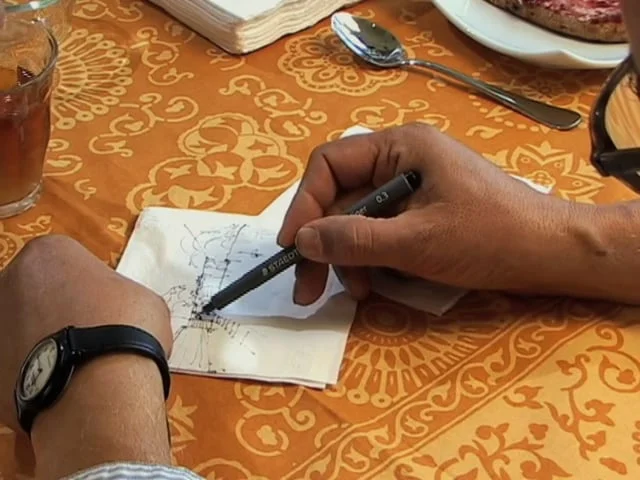
My father and I collaborated to create a model of this house, and in the process, I uncovered new stories about our life. I saw him, with excitement and anticipation, rebuild the room where my sister slept as a child, and the window he sneaked through to snoop on Soviet activity next door. I realized that the greenhouse he had appended to our house in Pullman, WA was not novel, but the successor to a floor-to-ceiling glass room on the façade of “Wazir Akbar Khan.” Upon looking at the small-scale version of her home, tears welled up in my mother’s eyes, a previously absent expression in regard to her memories of Afghanistan. Finally, I saw my 8-year-old nephew look, with glee and fascination, through the round circles of the courtyard, a defining design element of the house. It was as if this collaborative artistic process created a space to pass and process grief, allowing the next generation to simply admire its design, unmired by the melancholy and weight this structure has carried for the rest of us.
Buildings have feelings. They are formed not only by their human creators, but by those that come into contact with them. They express the spirit of their time, whether that is joy or scars. This house, in a corner of Kabul, bears as much the burden of history as the humans that surrounded it.